25 July 2026
The Ora Crown Dispute, Inside the 1980 Aboderin Commission of Enquiry
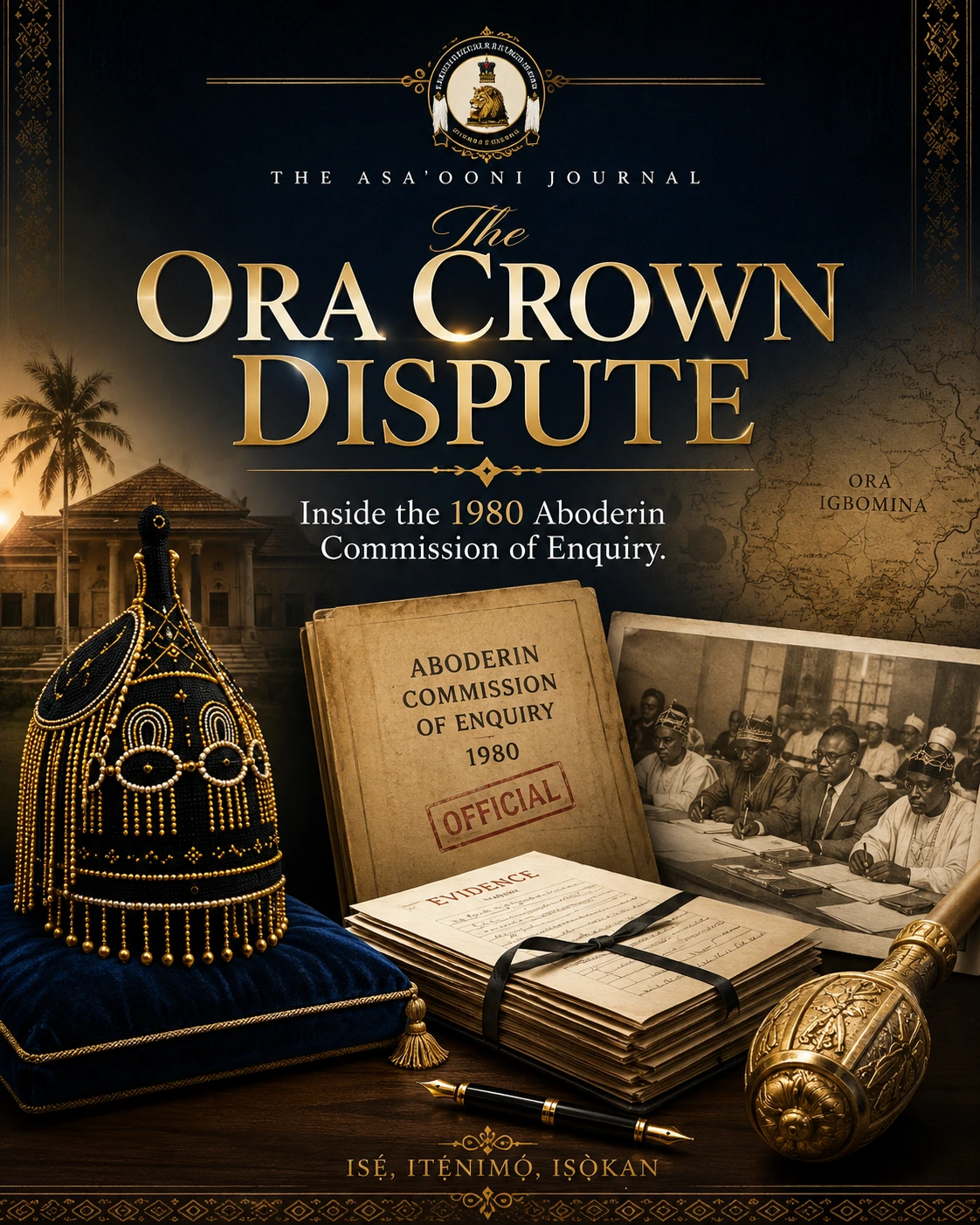
In February and March of 1980, a government-appointed panel sat for ten sessions in Ila Local Government, Oyo State, to settle a question that had simmered in Ora Igbomina for decades, whether the Akesin of Ora had any legitimate right to wear a beaded crown, the exclusive symbol of Obaship in Yoruba tradition, and whether the Asa-Ooni of Ora held the precedence that Ora’s own history says he does. The panel, chaired by Justice V. O. A. Aboderin and joined by Dr. Segun Odunuga and Mr. Akinola Oluwakuyide, left behind a transcript that reads more like a slow, methodical unravelling of a claim that could not hold up once it was tested under oath.
The beaded crown, or Adé, is not decorative in Yoruba political culture. By long-standing convention, only a ruler descended from Oduduwa, who is said to have carried a crown out of Ile-Ife when founding a new settlement, may wear one. Everyone else, however locally powerful, wears a cap. When the Akesin of Ora began appearing in beads, it was read for what it was, a claim to full Obaship, made in a town that, on the weight of the evidence in this record, had already had one Oba for centuries.
The Commission’s six terms of reference, read into the record on the first day, framed the inquiry as a test of two competing histories, only one of which could survive contact with the documentary record.
Between 19 February and 12 March 1980, Lawyer Mofoluso Bada, representing the Akesin and his chiefs, and Lawyer Abiola Orioye, representing the Asa-Ooni and the wider Ora community, brought a long line of witnesses before the panel. What emerges from their testimony is not a genuine dispute between two equally plausible accounts, but a sustained and largely successful cross-examination of the Akesin camp’s version of events.
Asa-Ooni’s case rests on a coherent line. His ancestor, Okese Oloja, fled Ile-Ife in the seventeenth century to escape being made Ooni. This fate had recently claimed several of his predecessors in quick succession, and he arrived in Ora carrying a crown, founding the only town that ever existed there. Akesin’s people, on this account, arrived far later, as the seventh group of settlers to be granted land in Asa-Ooni’s domain, tenants rather than equals.
Akesin’s camp told a different story, that his ancestor Alapameri left Ile-Ife around 1300 AD and founded a second, independent Ora. It did not survive scrutiny. Dr. Ololade Folayan, the Akesin side’s own expert witness, testified that none of the first fifteen Akesins reigned for less than seventy years each. Worked out on paper, that timeline places the first Akesin’s arrival in Ora around 800 AD, before Oduduwa himself is traditionally said to have lived, an impossibility that Orioye pressed hard in cross-examination. Folayan then conceded, under further questioning, that a living descendant of the first Akesin was only five or six generations removed from him, a generational count that places the first Akesin’s arrival in the mid-nineteenth century, not the fourteenth. The two figures cannot both be true, and only one of them survives contact with ordinary arithmetic.
The documentary trail compounds the problem for Akesin’s side. Multiple exhibits tendered by Orioye, agreements, petitions, and Native Authority correspondence from the 1940s and earlier, consistently refer to the reigning Akesin as a chief of Asa-Ooni, second in rank, never as an independent Oba. The Akesin denied signing several of them, insisting his thumbprint had been forged, a denial the Chairman pressed him on repeatedly without ever receiving a convincing account of who might have forged it or why.
However, both sides agree on one date, 1954, when the Orangun of Ila presented the Akesin with a beaded crown. Akesin’s side called it restitution. Asa-Ooni’s side, with the better documentary support, called it a political favor, a reward for testimony the Akesin had given in the Orangun’s own land dispute with the Asa-Ooni, granted without consulting the Asa-Ooni whom the Akesin had, on the record, previously acknowledged as senior. The Western House of Chiefs had already found the 1954 gift contrary to native law and custom on precisely those grounds.
The transcript carries both closing addresses in full. Bada’s submission for the Akesin argues, against the weight of everything that preceded it, that Ora should be recognised as two towns with the Akesin elevated to full Obaship. Orioye’s closing address for the Asa-Ooni is longer, more heavily documented, and considerably more persuasive on the historical merits, methodically drawing together the contradictions above and asking the Commission to strip the Akesin of any right to the crown, to any paraphernalia of Obaship, and to any chieftaincy-conferring authority, describing the Akesin institution as a source of unrest that has been, in Orioye’s words, inimical to good government and peace in Ora.
There is one further piece of evidence worth the reader’s close attention.
Embedded within the transcript of the fourth sitting, weeks before the hearings themselves had concluded, is a passage which recommends withdrawing the 1979 government recognition of Akesin’s crown-wearing, making Asa-Ooni the consenting authority over future Akesin appointments, and confirming Asa-Ooni as head of all chiefs in Ora, describing these conclusions as ones the Commission had reached only after reviewing government files unavailable to the parties themselves. Its early placement in the record likely reflects how the transcript was compiled rather than when the finding was actually reached.
Read alongside the rest of the record, it is consistent with everything else the evidence points toward, and readers going through the full transcript that follows this note will find that consistency holds from the first sitting to the last.
For the readers encountering this record for the first time, the transcript that follows tells a clear story, a claim to Obaship pressed hard by the Akesin’s camp, and dismantled, sitting by sitting, witness by witness, document by document, by a case for the Asa-Ooni’s precedence that the evidence itself sustains.
Supporting files
DAY-TO-DAY-PROCEEDINGS-OF-THE-COMMISSION-OF-ENQUIRY-INTO-THE-WEARING-OF-A-BEADED-CROWN-BY-THE-AKESIN-OF-ORA.pdf
pdf